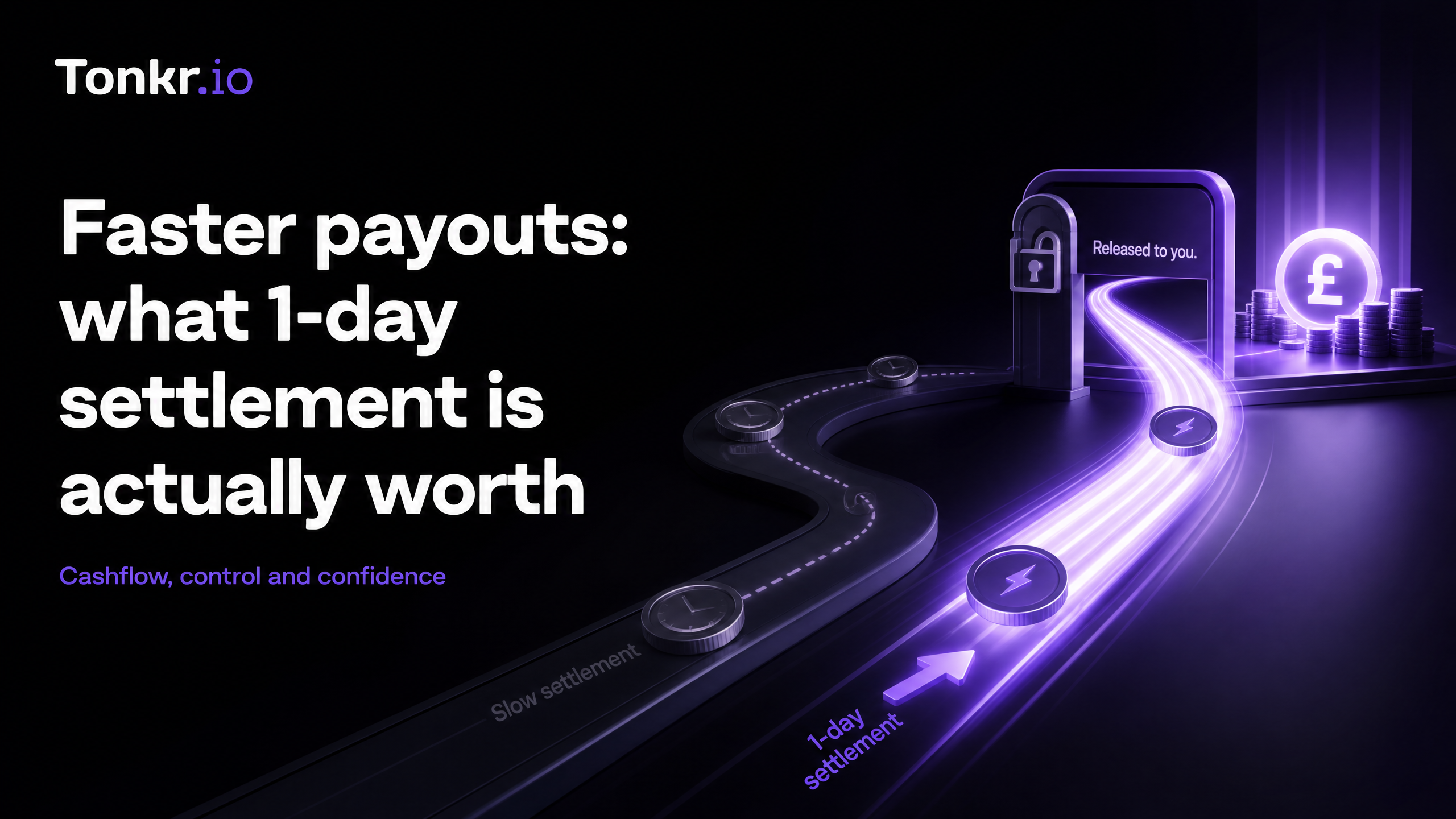
Payout timing differences of 1 to 3 days are a working-capital cost that compounds with volume and is rarely modelled in provider comparisons.
5 Key Facts
Platform-default payouts commonly settle in 3 to 5 days.Faster providers settle in 1 to 2 days.At £500k monthly volume, a 3-day delay ties up roughly £50k of working capital on any given day.The working-capital cost scales linearly with volume and is invisible on fee comparisons.Payout speed should be priced alongside fees and acceptance rates in any provider decision.
Provider comparisons rank fees, features, and support. They almost never rank payout speed, because it does not appear on any pricing page as a cost. It should, because settlement delay is working capital locked in transit, and at volume it is worth real money.
The mechanics
Most platform-default processing settles on a rolling 3 to 5 day schedule. Faster providers settle in 1 to 2. The difference sounds trivial until you do the arithmetic: at £500k monthly volume, average daily sales are roughly £16k, and each day of extra delay holds another day's revenue in transit. A 3-day gap ties up about £50k on a continuous basis.
What that capital is worth

For merchants running larger inventories, the value is more direct than an interest calculation: faster settlement funds faster reorders, which for seasonal stock can be the difference between catching and missing a selling window. For merchants running on overdraft or invoice finance, the saving shows up as interest not paid.
Where to find your number: payout schedules are in your provider agreement, not the pricing page. Check the settlement clock, cutoff times, and whether weekends count. Two providers both claiming "fast payouts" can differ by two full days in practice.
How to weigh it against fees
Payout speed is one of three numbers that belong in every provider decision, alongside effective fees and acceptance rate. A provider charging 0.1% more but settling a day faster is often the cheaper option once working capital is priced in. A provider charging 0.1% less with slower settlement can be the more expensive one.
Tonkr prices payout timing into every comparison. The free audit shows your current settlement profile, what faster providers offer, and the working-capital value of the difference at your volume. If switching is worth it, we say so. If it is not, we say that too.
Related reading
- The real cost of switching providers: plug-and-play vs bespoke